
Global Data, Reporting, and Analysis
ARiVA Intelligence Data Services is a one-stop shop for predictive, real time, and post-operational insights—fusing more than 60 different data sources into a “single truth” about flight, airport, and airspace operations. Globally scalable to any region, cloud hosted, with unmatched coverage, accuracy and reliability.
Whether it’s predicting gate arrival time, tracking flights over ocean, or comparing turn time performance – today’s complex aviation operations require precise, timely, and actionable data to support the demands of multiple operational scenarios and performance metrics.
ARiVA data services are built on the PASSUR global fused data architecture, which aggregates more than 50 upstream data sources and applies filtering, logic, AI and machine learning to transform this global data warehouse into data API streaming services, user friendly reporting dashboards, and direct query tools for deeper analytics.
Continuous “stream API” data feeds supporting third-party applications, in three different configurations, each addressing distinct requirements and use cases:
ARiVA Predictive Services provides advanced forecasting of flight arrival times, runway assignments, airfield movement times, and other operational conditions that are critical for ensuring a smooth functioning operation, anticipating disruptions, and allocating resources effectively. ARiVA Predictive technology is unique in the way it leverages a massive historical archive, machine learning, and AI to deliver early, accurate and actionable forecasts that drive multiple aviation systems and processes.
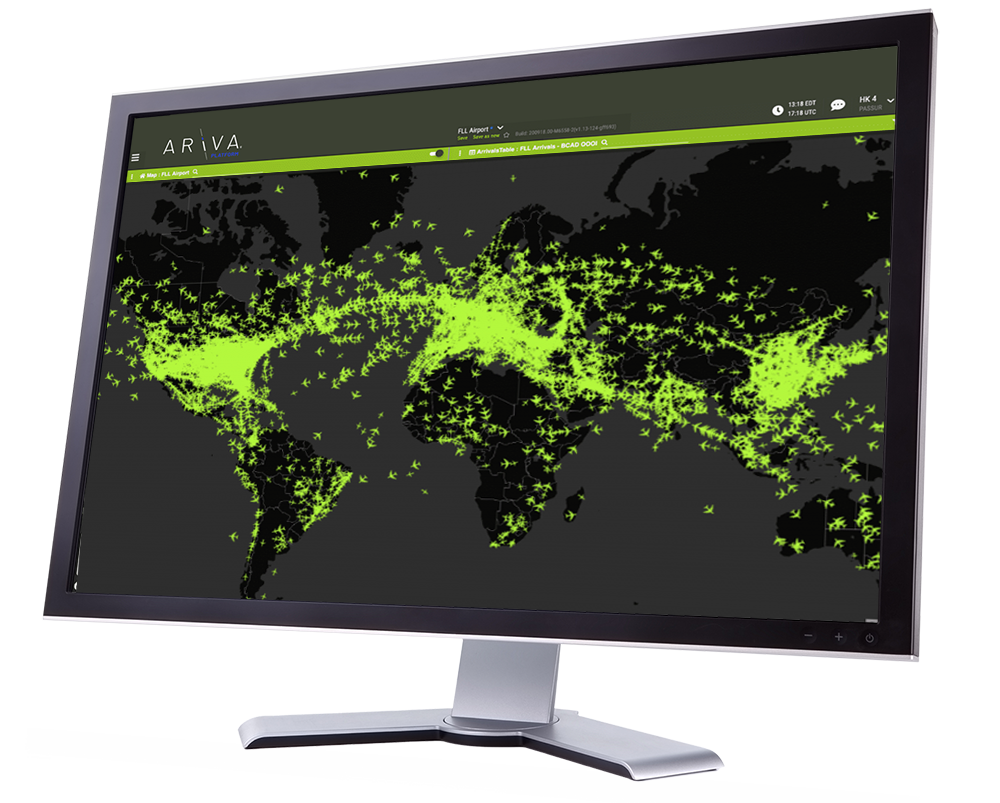
Global surveillance of 200,000+ flights per day through a global network of linked terrestrial and satellite resources, with granular updates of each flight trajectory, gate-to-gate. The AGF tracking feed is an advanced fusion of multiple data sources, with continuous selection of the highest-confidence target points, and extensive filtering and error correction to ensure accuracy and reliability. Thousands of aircraft around the globe are subscribed to this service, supporting daily mission-critical functions for airlines and airport operators.
Global, detailed flight milestones and associated data elements for flight operations and handling, across the entire trajectory of the flight. This is a rich feed information such as flight stage and status, gate assignment, bag claim, diversion, and many other elements that are so critical for the proper functioning of today’s data-driven aviation management systems. AGF FlightEvents consolidates these disparate pieces of information into a single, powerful stream of flight information updates.
Instant access to rich data enables user-friendly reporting dashboards, and direct query tools for deeper analytics.
Provides direct query access via API to the breadth and depth of the ARiVA global data warehouse, supporting multiple business, operations, and financial requirements – both historical analysis and real time dashboards. This service unlocks the power of the ARiVA aviation data archive to support any system or team requiring rich data to support analysis, reporting, performance metrics, and other detailed data-driven services, including AI platforms and services.
A flexible, intuitive interface – ARiVA Portal – provides immediate access to standard and ad-hoc reports with multiple filtering options. This is a fast and simple way to access structured, formatted reports on a multitude of operational metrics and activity, with options for different historical look-back periods and optional additional reference data bases. Ideal for setting up regular reports of key metrics or creating a performance baseline to continuous improvement initiatives.
Reduced taxi times
Improved connections (bags, passengers, crew)
Lower fuel burn (cost and CO2 emissions)
Improved airline block time performance/aircraft utilization
Streamlined ground handling labor allocations and costs
Improved On Time Performance
Feeds any airline system dependent on accurate forecasts of flight demand and flight status, e.g.:
Improved gate assignment/gate utilization
Streamlined ground handling labor allocations and costs
More efficient use of hard stand and remote stand assets
Advance notification of delays, congestion, constraints and other unpredictable factors to minimize passenger and airline disruption
Feed airport AODB and ACDM systems dependent on accurate forecasts of flight demand and flight status. Other systems include:
Single, consolidated data service with best-in-class predictions, flight tracks, and flight milestones to feed systems such as digital flight following, electronic flight bag, ACDM, Surface and Safety Management, ground handling, etc.
Alerts, status and tracking of flights of interest for border security and intelligence systems.
Secure the optimal mix of data sources for the most complete fleet coverage at the best cost
“Synthetic logic” and extensive redundancy fills gaps in key data elements
Supports enterprise-level, hyperscale integration
Error correction logic addresses jamming, spoofing, and other anomalies
Operations performance analysis and improvement (OTP, turn time, block time, runway usage, etc.)
Competitive analysis (own performance metrics vs. competitors)
Financial analysis (efficiency and completeness of aeronautical fees management, fuel costs, block time costs, aircraft utilization, etc.)
Schedule and route analysis
Environmental analysis (noise and CO2 emissions)
Real-time operations statistics dashboards
Daily, weekly, or monthly operational statistics and reports
Slot compliance reporting
Runway, gate, remote parking reporting
Congestion, throughput, and efficiency analysis
Comparative analysis between airports
Reports for aeronautical charges tracking, auditing, and invoicing
Environmental analysis (noise and CO2 emissions)
Real-time operations statistics dashboards
Supporting deep analysis, reporting, metrics and dashboards for aviation consulting firms to provide to their end customers
Competitive market analysis
Analysis for pricing and marketing programs
Acquisition analysis and planning
Loyalty program tracking and auditing
Asset utilization tracking (e.g., aircraft usage, such as takeoff/landing cycles, locations of operation, etc.)
Contractual compliance
Legal audits
Market analysis
Competitive analysis